Castles in Spain: the Alcazar of Segovia and Manzanares near Madrid

Spanish castles:  Manzanares
 

A small, 'late' but very pretty castle in the town of Manzanares, a short drive from Madrid.  Hemingway mentions the adjacent town in For Whom the Bell Tolls.  This picture was taken in 1971, several years before a restoration program rebuilt the interior of the castle and stairs were added leading to the entry you see here.

Friends of mine, American expatriates, and I would drive here often on Sunday afternoons.  At the time, the castle was just an outer shell with two interior courtyards divided into upper and lower floors open to the elements.  One detail I remember quite well is that an old woman from the village had taken it upon herself to put a lock on the construction workers' gate.  For a few pesetas she'd open it and let you inside, telling you a little about the castle's history.

My graduate advisor, the poet Arturo Serrano Plaja, came from El Escorial, not far from here.  I'll always remember his fascination with all the different countries my ancestors had come from... almost as amazed as I was in my attempt to comprehend that all of his had come not just from one country but from a single town.
 

The Alcazar of Segovia


The Alcazar seen from the plain below, at the confluence of the two rivers that border the city.

The word alcazar comes from the Arabic and means 'castle'.  Many Spanish words beginning with 'al' indicate Arabic origins, a reflection of the fact that Spain was under Arab control from the early 700s through 1492.  These pictures were taken during the late fall of 1970, when I was a student living in Madrid.

This castle has been used many times in advertisements, and appeared as Lancelot's castle in the 1960's movie 'Camelot'.

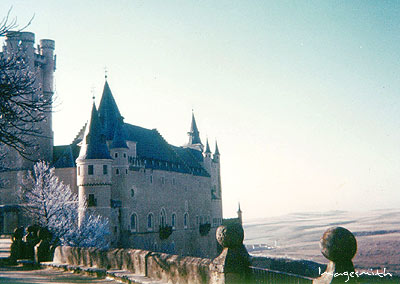
The alcazar seen from its entrance at the city's edge.  The arched window in the middle of the row along the side of the building marks the great hall where Queen Isabel received Columbus. 
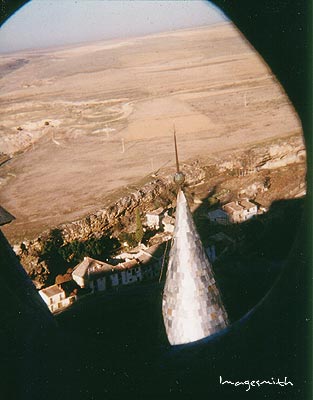
This picture of the plain below the castle was taken from the round window of one of the dungeons high in the castle towers.  It was December and so cold that my feet felt like they were freezing to the stone floors through my shoes.  But it made me understand why the dungeons had been placed here instead of in the basement somewhere.  Note the characteristically barren central Spanish landscape.  When questioned about the lack of trees, Spaniards will tell you that the Moors brought herds of goats when they invaded, which then proceeded to eat off all the vegetation.  Which sounds very implausible... unless you've seen the handiwork of goats firsthand.
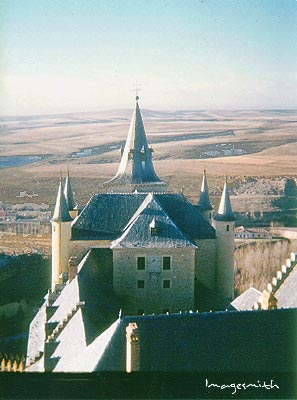
Climbing the circular stairway past the dungeons brings you eventually to a high patio at the front of the castle, where you can look out, seemingly almost forever, over the dormant plains. 


To MyWorld and other tour options  |  To Imagesmithstudio  |  Contact bardsmaid

copyright 2002, bardsmaid