|
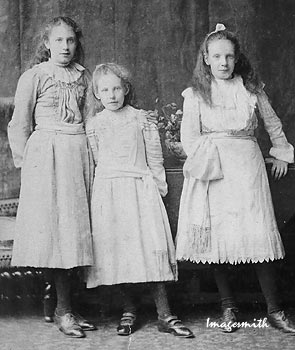
Grandma is the one in the middle |
S h o r t F i c t i o n
/ E s s a y s
My Grandmother
There came a time when my high school
English teacher (she of the many essay assignments and the enthusiasm for
Shakespeare, both very good things as it turned out) asked us to write an
essay about someone we admired. I pondered... and almost immediately, to
my surprise, settled on my grandmother. It wasn't that she'd become
Somebody--rich or famous or influential outside the radius of her own
family. It was what she'd done with the raw materials she'd been given
that impressed me.
|
|
And raw they were. Her father was a
violent, abusive man. He drove his wife into alchoholism, after which she
was declared an unfit mother. Her three daughters (Florrie, Amy and the
youngest, my grandmother Bessie) were placed in a San Francisco orphanage
and their father disappeared from the area for several years. When he
returned, he retrieved the girls from the orphanage (my grandmother was 7
at the time) and whisked them away to the northeast of England to stay
with relatives while he went off to South Africa to seek his fortune in
the diamond mines. The year was 1899.
The girls, left with the family of one of their father's brothers, were,
unbeknownst to their father, used as household servants, polishing stairs
and balustrades and the family silver each morning before school and
scrubbing the stone floors of the local parish church, for which their
guardian served as caretaker. Florrie, the oldest, suffered from swollen
knees for the rest of her life. My grandmother remembered receiving an
orange or a handkerchief as Christmas gifts (not both in the same year,
however.)
The girls spent eight years in the little seafaring town of Whitby, North
Yorkshire (birthplace of the Endeavour, ship of the famous explorer
Captain Cook), at which point their father returned and reclaimed his
daughters, taking them home to San Francisco. Relatives remember that the
girls were reluctant to leave, though they had no idea why.
The three had, at least, missed the great San Francisco earthquake of
1906. But their father had not changed. Within months Amy had run away
from home, apprenticing herself to a milliner. Eventually she became a
famous San Francisco hat maker in her own right. Florrie and Bessie
followed her example soon after, fleeing across the bay to Mill Valley,
where they worked as governesses for wealthy families. The kind of abuse
the girls had suffered was never discussed, but recently my sister told me
that Florrie had confided to her that her father had once thrown her
against the wall so forcefully that she lost her hearing for several
months.
I remember my grandmother as a smiling woman with a twinkle in her eye.
She was not very mobile when I knew her; walking was painful for her. But
we went into the backyard together (there were blackberry vines at the top
of the tiered hillside garden my dad had constructed.) We baked wonderful
coffee cakes together from scratch, gathered up the dry bread crusts she
always saved for when we came and took them off to Golden Gate Park to
feed the ducks, a highlight of our visits. She made plum pudding for
Christmas, magically coaxed traffic lights into turning green (it took us
a little while to figure out how she did this), and always seemed to
possess a certain childlike wonder that the adults around her had
'outgrown'. She was the one grownup I knew who had retained her sense of
wonder, and I loved it.
It was from Florrie and Amy that we learned how the three had been treated
as girls. But Grandma never dwelt on the rigors of their life in Whitby.
She would tell us about Whitby's beach, or about how kind her cousin
Willie the baker had been to her.
She could have done otherwise. She could have felt burdened or put upon,
or justifiably bitter about her growing-up years. But she wasn't that kind
of person. She played cards with us, laughed with us, and sewed me
amazing, intricate outfits for my dolls. She was warm and welcoming, the
kind of person a growing child could confide in and count on being taken
seriously. Perhaps most importantly, she was a wonderful example of a life
lived with appreciation and a conviction that she need not continue to be
bruised by the harsh bindings of her past.
site design ©
bardsmaid 2005 | Hosting by
NinePlanets
|
